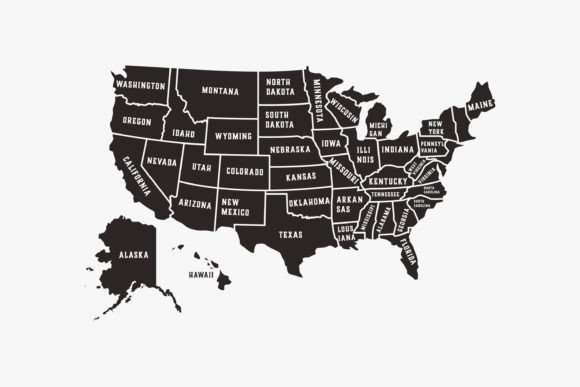
Visualizing America: A Versatile Vector Map Asset
There is a specific kind of frustration that hits when you are working on a large-scale campaign, and you realize you don't have a decent map of the United States that actually works with your brand. You search for stock imagery, only to find low-resolution JPEGs that pixelate the moment you try to scale them up for a trade show banner, or overly stylized graphics that look cheap on a business card. If you have ever struggled to find a balance between quality and versatility, the Graphic Vector Map of United States solves that problem elegantly. This isn't just a static image; it is a fully scalable, editable design asset built for professionals who need precision and flexibility in their projects.
The Power of True Vector Scalability
When we talk about this asset, we aren't talking about a traced image that looks okay at medium size. The Graphic Vector Map of United States is built on mathematical paths, meaning it is true vector artwork. In practical terms, this means you can take this file and scale it to fit a tiny icon on a mobile app or blow it up to cover the side of a delivery truck, and the lines will remain crisp and clean. There is no loss of quality, no jagged edges, and no blurring. For a designer or business owner, this is the difference between a project looking amateurish and looking professional.
The asset comes equipped with a robust set of file formats to ensure it fits into almost any workflow. You will find AI and EPS 10 files for those working in Adobe Illustrator or other professional vector software. It also includes PDF and SVG formats, which are incredibly useful for web design and printing. For those who need ready-to-use graphics without opening complex software, there is a PNG file with a transparent background (specifically without text) and a JPG for quick previews. This versatility makes it a premium asset for anyone from a freelance graphic designer to a marketing department at a large corporation.
Practical Applications Across Industries
So, where does a vector map like this actually fit into your daily grind? The applications are surprisingly broad. If you are a blogger writing about travel, logistics, or regional trends, this map allows you to highlight specific states or regions with custom colors without needing to redraw anything. It integrates seamlessly into editorial design, helping to break up text-heavy pages and provide visual context that keeps readers engaged.
For entrepreneurs and small business owners, the map is a powerhouse for brand identity. Imagine using it to show your service areas on your website, or printing it on promotional materials like tote bags or t-shirts. Because the text is non-editable in the final renderings (though the vector paths are fully editable), you have the freedom to overlay your own typography—whether that is a bold sans serif font for modern clarity or a classic serif font for a traditional feel. It serves as a background for social media graphics, allowing you to create eye-catching posts that announce sales or events in specific locations.
Marketers will find this particularly useful for data visualization. Instead of relying on clunky chart tools, you can use this asset to create custom heat maps or demographic graphics for presentations. It elevates the perceived professionalism of your pitch decks and client reports. Even crafters and hobbyists can utilize the SVG file for laser cutting or vinyl decals, creating custom wall art or personalized gifts with precision.
Design Flexibility and Aesthetic Control
One of the standout features of this Graphic Vector Map of United States is the control it gives you over the visual hierarchy. In design, hierarchy is about guiding the viewer's eye to what matters most. With a fully editable vector file, you aren't stuck with the default colors or line weights. You can adjust the stroke weight to make the state borders more prominent or dial them back for a subtle, textured look.
This level of control allows you to match the map perfectly to your brand identity. If your brand uses a specific shade of blue, you can apply it instantly. If you are working on packaging design and need the map to blend into a complex background, you can adjust the opacity or remove fill colors entirely. It works harmoniously with other design assets. You could pair it with a handwritten font for a rustic, personalized feel, or combine it with a modern typography stack for a sleek, tech-forward aesthetic.
Because the file is so clean, it supports complex font pairing without visual clutter. If you are designing a logo that incorporates a map element, this asset provides the clean foundation you need. It ensures that your logo design remains legible and balanced, even when the map is reduced to a very small size. The ability to edit individual anchor points also means you can customize the shape of states if you need to emphasize a specific area for a marketing campaign.
Evaluating the Asset for Your Workflow
Before you integrate any asset into your library, it is worth doing a quick evaluation of how it fits your specific needs. First, consider your primary medium. If you are strictly doing web design, the SVG and PNG formats will be your best friends due to their scalability and fast load times. If you are focused on print—such as flyers, posters, or merchandise—the AI, EPS, and PDF formats ensure that your printer gets the high-resolution data they need for crisp output.
Next, think about the "personality" of your project. This particular map style tends to be clean and versatile, making it a "neutral" canvas. It doesn't scream for attention on its own, which is actually a strength. It allows your typography and other design elements to take the lead. Whether you are using a script font for an elegant wedding invitation or a heavy display font for a concert poster, the map adapts to the mood you set.
Finally, remember the licensing aspect. This is a commercial font and asset, meaning you are cleared to use it in projects that generate revenue. This is crucial for entrepreneurs and agencies. You can use it in client work, merchandise, and digital products without worrying about copyright infringement. Having that peace of mind allows you to focus on what matters: creating engaging, high-quality content that resonates with your audience.
Final Thoughts on Utility
In the world of digital assets, utility often trumps novelty. The Graphic Vector Map of United States isn't just a pretty picture; it is a tool. It bridges the gap between complex data and visual storytelling. Whether you are a publisher laying out a geography textbook, a marketer creating a targeted ad campaign, or a hobbyist making a custom gift, the ability to manipulate this map at any size is invaluable. It saves you time, ensures consistency across your media, and ultimately helps you communicate your message more effectively.